

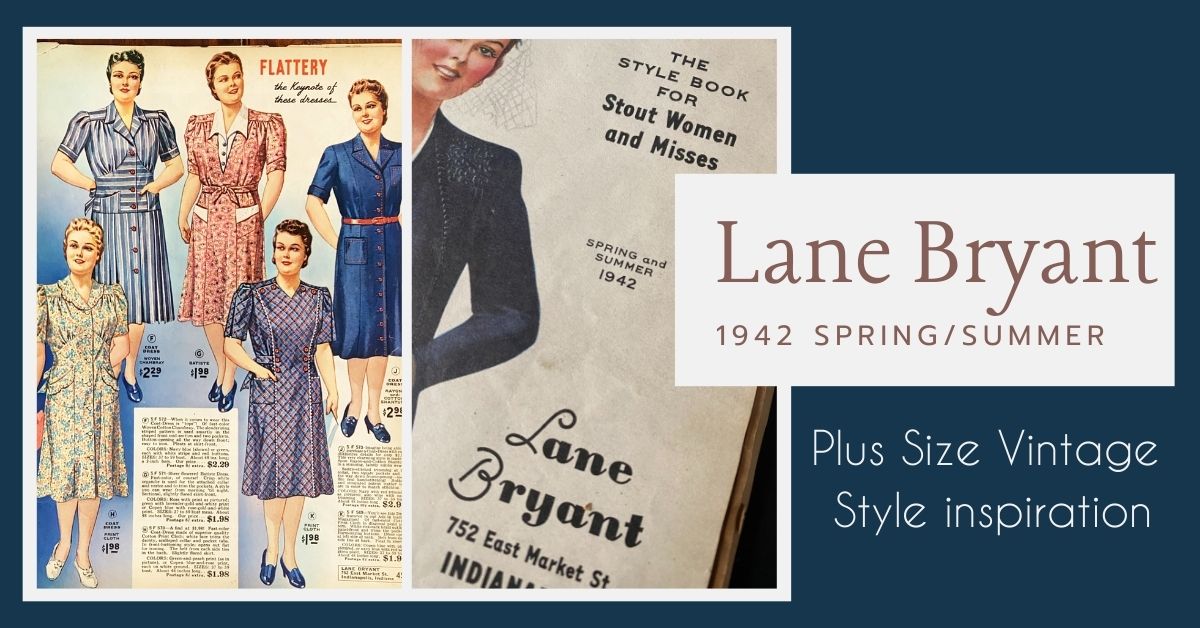
1942 Plus Size Vintage Styles from Lane Bryant Catalog
- May 27, 2021
- by
- The Glambassador
A few months back I wrote a blog post for the 1956 Lane Bryant Catalog I acquired and now I’ve gotten my hands on this 1942 Spring/Summer Lane Bryant Catalog along with a few others from the late 1940s and early 1950s.
I love seeing these vintage designs for plus size women and seeing how they are styled. It gives me so much inspiration for my own styling. Catalogs are a valuable resource and wonderful way to really understand the fashion of the era, these were garments that everyday women bought and wore. And the fact that this was right in the beginning of wartime in America, it’s a great snapshot to see what styles were in fashion and to see what types of fabrics and details were being added or subtracted from the previous years due to rationing.
I love looking through these old catalogs and seeing a lot of the same details in items I already have in my wardrobe. I also make note of specific details on necklines, sleeves, hem length and fabrics so when I’m putting an outfit together I can look to these resources to put together the most authentic ensemble I can.
As these catalogs are quite fragile, I wanted to preserve them by scanning them in and sharing it with you. I’ve included some of my favorite pages here, but you can flip through the entire catalog below. You can also find all of the images on my Pinterest page.
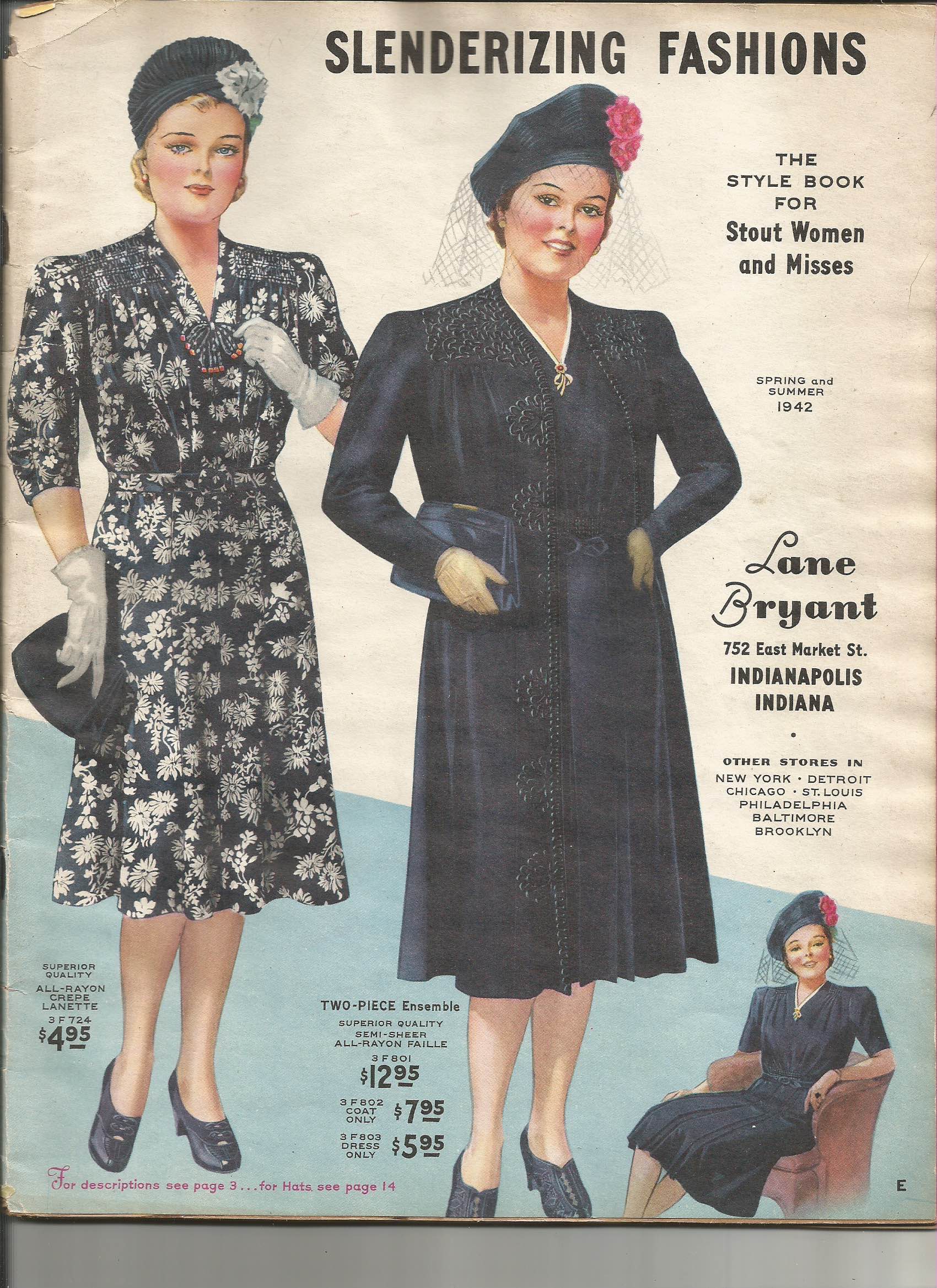
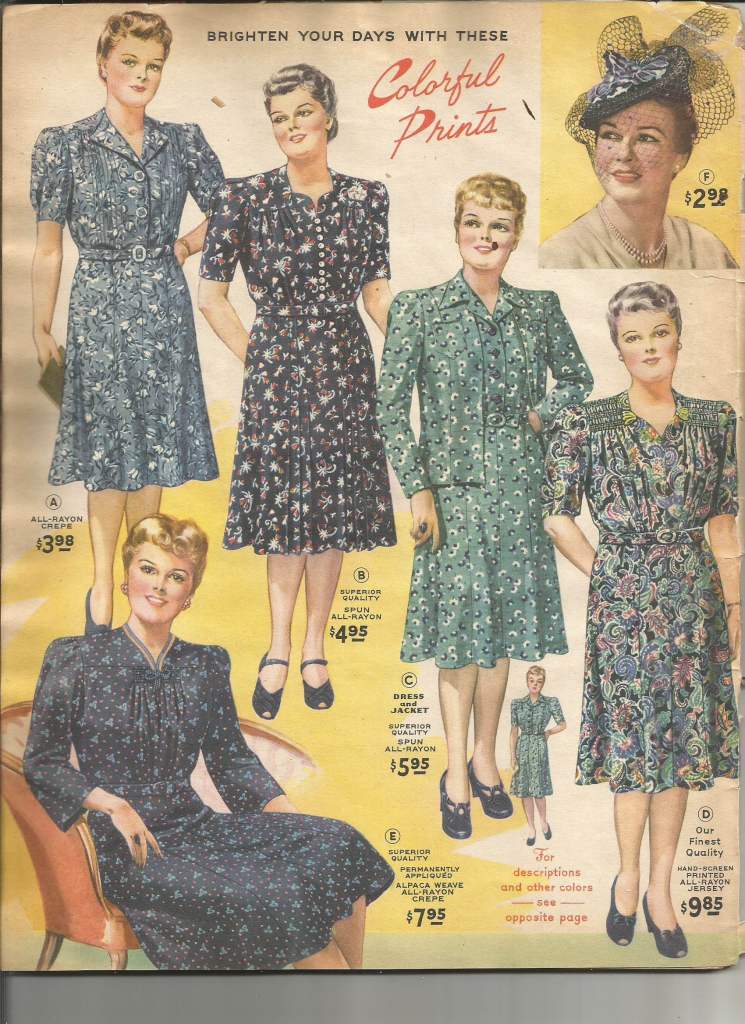


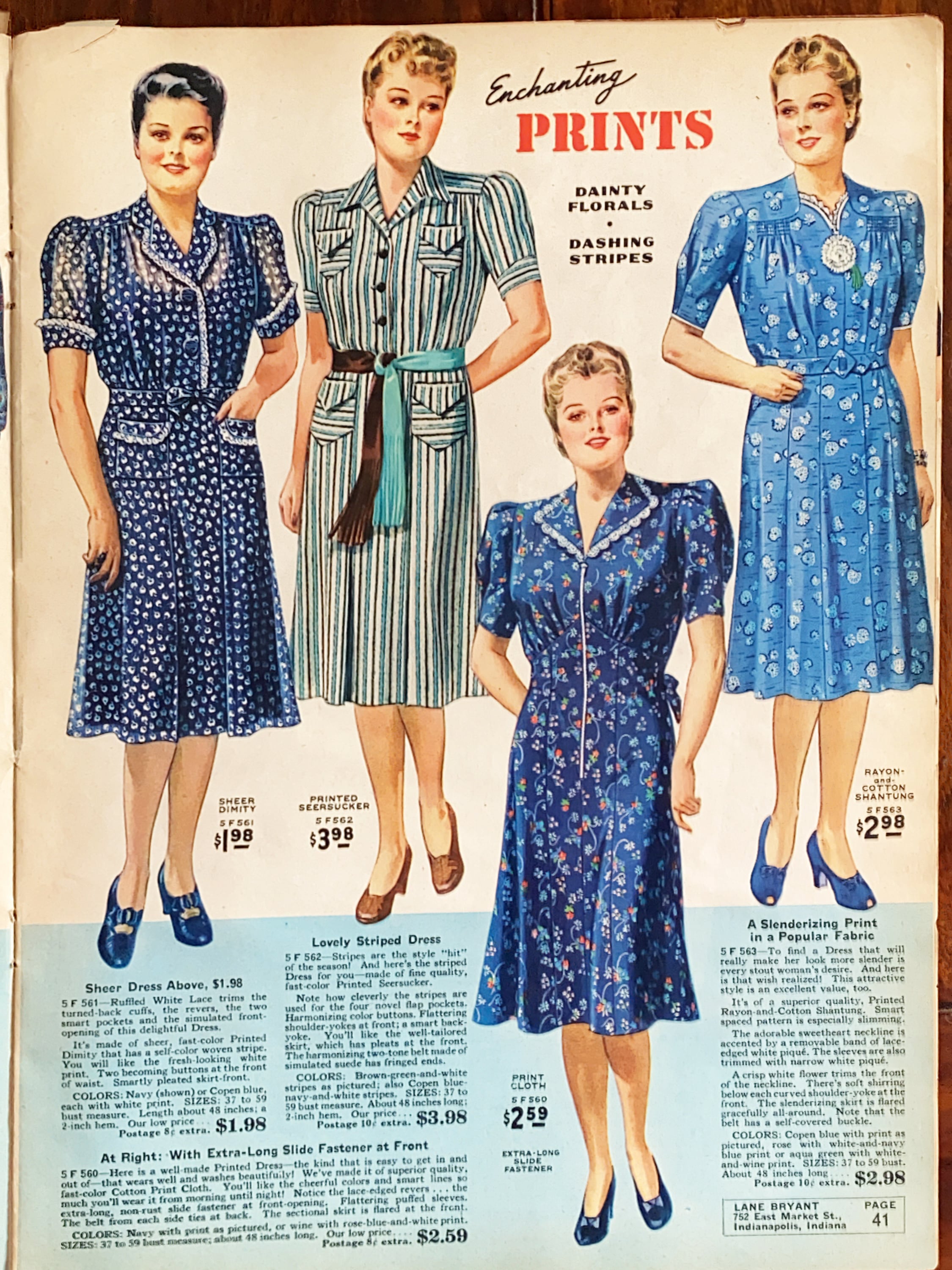


1942 Spring/Summer Lane Bryant Catalog

Discover more from Chronically Overdressed
Subscribe to get the latest posts sent to your email.
You may also Like
A Colorful Spring Day in Vienna


5 Comments
Vintage Fashion Inspiration 1947 Montgomery Ward Catalog
31st May 2021 - 6:02 am[…] 1942 Plus Size Vintage Styles from Lane Bryant Catalog […]
saree
5th Jun 2021 - 11:57 pmNice to have a look at these again Whole catalog is awesome to see. The sneakers models just look like in the old movies.
Stacey
22nd Jul 2021 - 5:28 amThank you for loading all of this! I wish they still made such a collection today! I would buy and buy lots!!
1940s Lane Bryant Stoutwear Fashions | Sew Last Century
1st Feb 2022 - 9:30 pm[…] Spring/Summer 1942 is available on Chronically Overdressed. […]
Shari F Davenport
26th Aug 2023 - 11:57 amLooks like somebody was asleep at the layout board, regarding Page 3! Upper left, in describing the outfits shown on the cover, has the images (or the descriptions) flip-flopped!
I was kind of confused for a moment, when reading the description purported to describe the image shown right next to it, but after comparing the top description with the bottom image, finally figured out what happened!
I love these catalogs, as I have always had an interest in all things 40s, especially the women’s clothing. As I have aged – I’m now 66 – I have of course developed an appreciation for the styles of the times. There are so many that I think I would want to wear now, even though they are anything but modern. The early to mid 80s saw a resurgence of 40s styles for a few years, and at that point, I was working in offices, and “front line” positions – office manager for a one-person office for a large Cable Company; a switchboard operator/front desk receptionist for a rapidly growing Cellular Phone Company; circulation and sales departments for a medium sized newspaper requiring daily in person contact with the companies which advertised with them. So, dressing the part became easy, and I had fun with it in that respect. However, it started becoming more of a challenge when my weight also became challenging.
My mother battled her weight since before I was born in 1957, and as long as she’s been alive since then. Even to the point of those 1960s diet pills, which were actually doctor-prescribed amphetamines; those unfortunately-named “Ayds” candies which were supposed to “fill you up” along with a cup of coffee, hot tea, or broth, before every meal; and to the point of surgery in the mid 70s to have her stomach “Stapled” – possibly something called a “Roux-en-Y” procedure. (I became a Certified Surgical Technologist in the early 90s and learned ALL about those.) The weight fell off her after that for well over a year, but after several more years just “stopped working,” and just left her with some seriously malfunctioning digestion.
Anyway, in the meantime, we always had these catalogs all over the house, and as a tall, skinny child and teen, was literally grateful I didn’t have to shop from them, as I was of course of a young mindset ready to dress like my peers, not like my mother. Even their “modern styles” didn’t appeal, as there were no midriff tops, hip hugging bell bottoms, hot pants, mini skirts, Jessica McClintock Gunne Sax prairie and Victorian style dresses and tops! My wedding gown (See thumbnail pic) is indeed a Jessica McClintock in size 13, more to account for my height (5’8″) than my size. An 11 would have done nicely, except for the length. The 13 was long enough, but a tad bit bulky on my frame, but I made do. It would not have been easy to alter, given all the seams and trims involved.
But, these catalogs, especially the wartime issues, which showed the wartime fabric restrictions on trims, certain dressmaker features like patch type pockets, sleeve and pants cuffs, dress and skirt pleats, length of hemlines, the change from floor length cocktail gowns to streetlength cocktail dresses. Then there were the restrictions on civilian use of leather for belts, and especially shoes to three then two pair per person per YEAR, regulated by ration coupons, which generated quite the interest in shoes made of brightly colored fabrics and nonleather, painted or fabric-covered wooden soles, heels and platforms! Even certain colors, given the restrictions on or shortages of certain chemicals used to produce the dyes in the civilian market.
Then there were severe, total restrictions on platinum, which was needed for use and development of electronics devices strictly for the military. Initially, there were also going to be restrictions or limitations on gold, and the alloys used to produce certain colors of gold, like white gold, rose/pink gold, and green gold, but the jewelry industry, particularly those who produced primarily wedding bands, engagement rings, and sets, appealed to Congress on a “civilian AND military morale” basis, given that so many weddings had already begun to, and would be anticipated in future, because of the War, should not be severely restricted to weddings and engagements without the ubiquitous wedding bands (including for grooms as well) and engagement rings for fiancées left behind on the home front without their almost requisite diamond ring. Sizes of diamonds could be easily managed, and use of small amounts of white gold could be used to create mountings that magnify the apparent size of the stones, or even their absence. JR Wood/Artcarved, Keepsake, as well as Orange Blossom/Traub were key players in this lobbying, in addition to others, and Congress agreed, as long as civilian supplies were not used to affect military needs. So, the ubiquitous two piece wedding set with the particular 40s design seen in so many of those later Art Deco sets, plus the individual wedding bands of numerous designs and styles, from the ever-popular plain, polished band of many widths and thicknesses, to those primarily produced by the use of carving, engraving, chasing, and other metal alteration techniques done by casting/molding, or by hand engraving, were the most prevalent during and just after the war years. Diamond sizes increased after the war, to allow for the most use during the war by using smaller but more plentiful sizes so that almost every ring would have at least one, even if small. I have seen vintage 40s sets that actually had none at all, on purpose, in order to make the appearance from a short distance of diamond sparkle, by using white gold “miracle head” or “illusion style” heads or settings that made the appearance of a stone by carving, etching or otherwise creating tiny “foldings” of white gold to catch the light and give the appearance of sparkles. This also allowed some of the most “financially challenged” of newly drafted grooms, or those declared to be either essential to the war effort to not be drafted but remain in activities like farming; or to be declared 4-F by virtue of a health condition, to be able to present their bride-to-be with a pretty wedding set she could admire, without totally breaking the bank.
Even costume jewelry was heavily affected, which saw chunky, bright materials like bakelight and clear plastics, fabrics, and the patriotic theme of red, white and blue became a heavy favorite, etc., and they were used to produce newer styles and more visible statement pieces that could help make up for the lack of trims on clothing, and help alter the appearance of outfits without trims. A different pair of earrings, along with a large brooch or a statement necklace could help change a simple outfit easily, and expand wardrobe choices.
Yes, this got deeper into “the weeds” than I intended, but it’s all relevant to the war effort, which was just getting up to speed.